

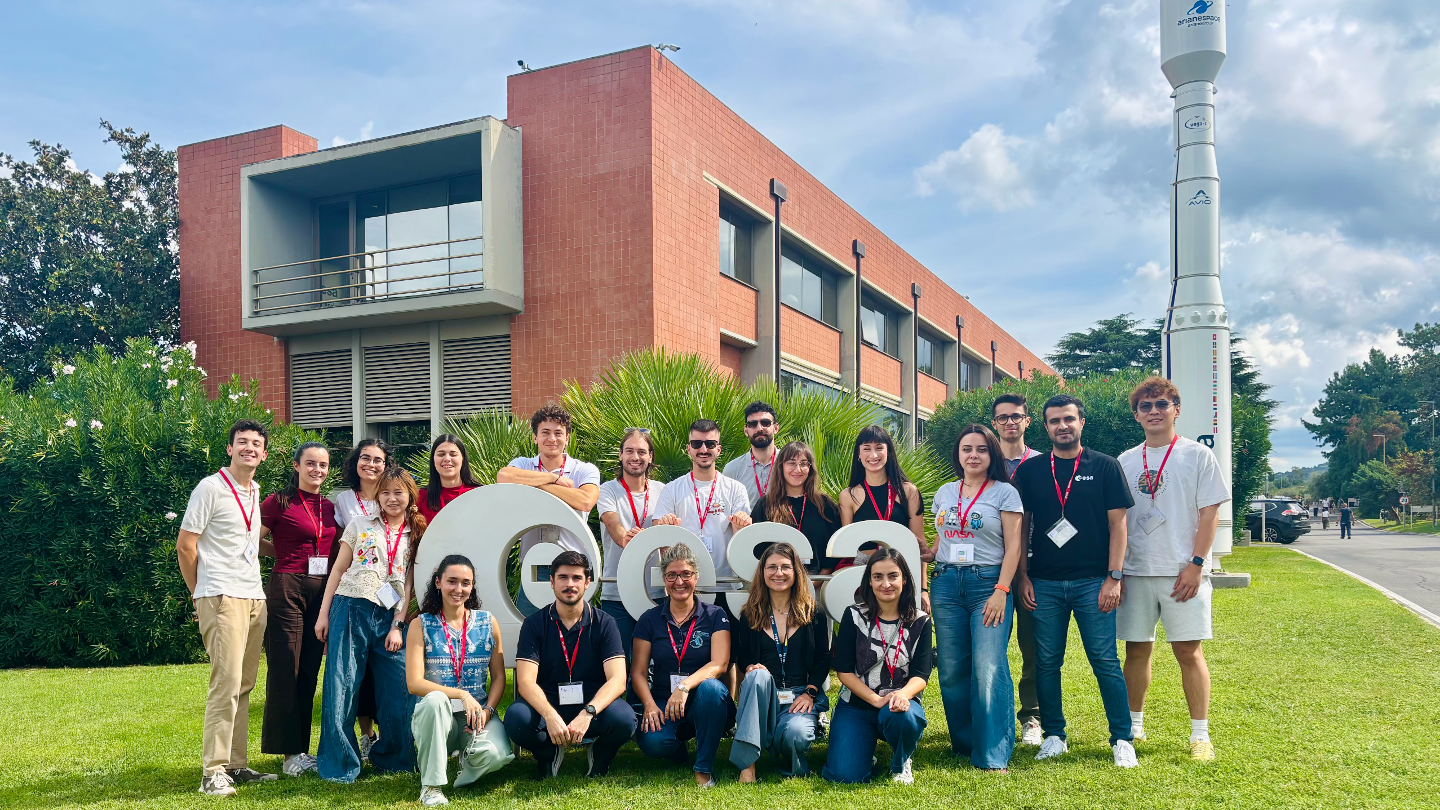
Science Hub Challenges 2026 kicked-off
- Post by: Anca Anghelea
- September 21, 2026
Educating the next generation of Earth Observation Scientists from Politecnico di Milano and Aristotle University of Thessaloniki, during the Science Hub Challenges 2026
Introduction
The ESA Science Hub Challenges are an innovative initiative designed to give graduate students hands-on experience in applying Earth Observation (EO) data to real-world scientific and societal questions. Organised at ESA’s ESRIN establishment in Frascati, the programme brings together students, university staff, ESA experts, and technology providers for an intensive week of learning, collaboration, and scientific exploration.
Following their selection for the 2026 edition of the ESA Science Hub Challenges, students and researchers from Politecnico di Milano and the Aristotle University of Thessaloniki joined ESA at ESRIN for a five-day workshop focused on developing data-driven narratives around some of today’s most pressing environmental and climatic challenges.
The Week in Brief
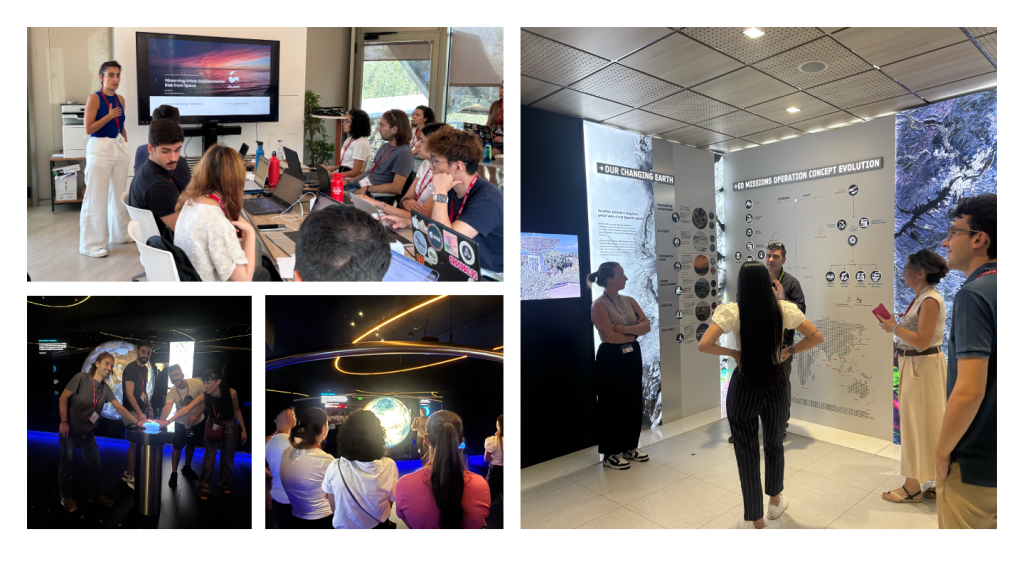
Throughout the workshop, students were introduced to ESA’s Earth Observation activities, scientific research priorities, and data infrastructures. The programme combined lectures, expert mentoring, hands-on project work, and opportunities to engage directly with ESA scientists and Earth Observation specialists.
Workshop Programme
Monday, 14 September
- Welcome to ESA and Science Hub (Diego Fernandez, ESA)
- FAIR and Open Science Principles (Anca Anghelea, ESA)
- EO for Urban Pollution and Heat Discomfort (Ana Oliveira, Colab+Atlantic)
- ESRIN Visitor Centre and Φ-experience visit
- Team formation & introduction to the challenges
Tuesday, 15 September
- Atmospheric Science Cluster (Edward Malina, ESA)
- Policy Perspectives on Atmospheric Science (Christian Retscher, ESA/DG CLIMA)
- Team project work
Wednesday, 16 September
- Sentinel-2 and Sentinel-2 Next Generation Missions (Rosalinda Morrone, ESA)
- LSTM Mission (Antonio Novelli, ESA)
- AI for Climate Science and EO for Health (Amy Campbell, ESA)
- Team project work
Thursday, 17 September
- EarthCARE Mission (Bjorn Frommknecht, ESA)
- Φ-Lab visit
- Team project work and preparation of final presentations
Friday, 18 September
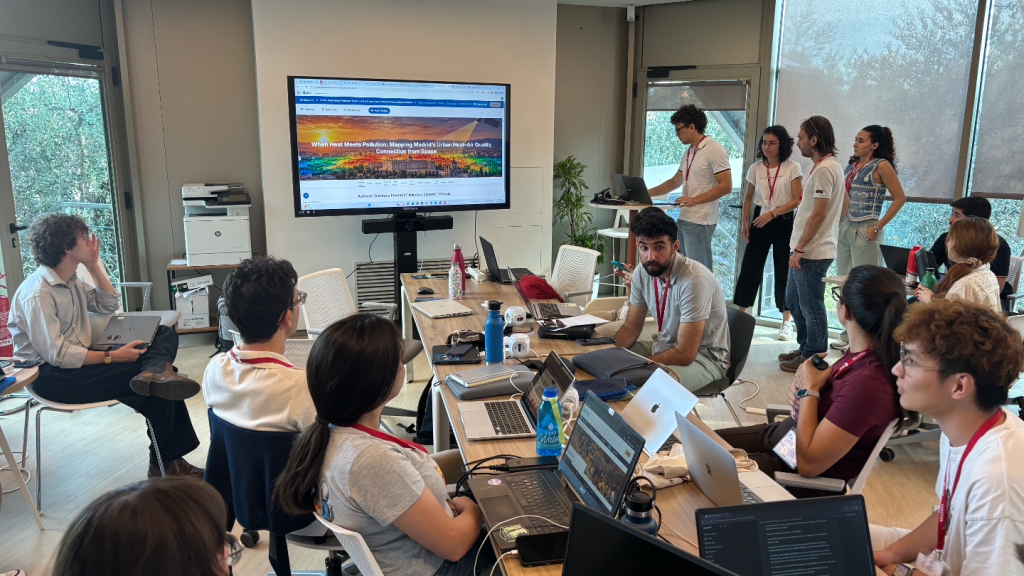
- Student team presentations
- Feedback and discussion
- Workshop closing
Scientific mentoring and challenge support were provided by Ana Oliveira (Colab+Atlantic), who guided participants through their scientific analyses and interpretation of their results. The computing environment was the Atmosphere Virtual Lab, provided by S&T, which offered direct access to cloud computing resources, EO datasets, and analysis tools. As part of the workshop programme, students also learned about the broader ESA Earth Observation ecosystem and explored how satellite observations contribute to understanding and addressing major societal challenges, from providing the scientific basis to supporting the definition of policies and monitoring their implementation.
The Scientific Challenges
Working in four interdisciplinary teams, the students addressed four sub-challenges drawn from two broader challenge themes:
- Air pollution risk mapping with Sentinel-5P and socio-environmental indicators
- Synergy between air pollution and urban heat: linking NO2, LST, and air temperature
- Unsupervised characterisation of urban thermal environments
- Mapping urban heat exposure and vulnerability
The projects focused on the use of Earth Observation data to better understand environmental pressures affecting urban populations, including issues related to air quality, urban pollution, and heat stress.
Throughout the week, participants explored satellite observations, environmental indicators, and complementary datasets to investigate the underlying drivers of these challenges and communicate their findings through data-driven storytelling.
From Data Analysis to Storytelling
As in previous editions, the Challenges were not only technical – as students had to interpret their results in the context of their relevance for society. Rather than producing only technical analyses, the teams were tasked with transforming their results into engaging narratives that could communicate scientific insights to a wider audience. To achieve this, participants used the EO Dashboard Narrative Editor, a collaborative tool that allows users to create interactive Earth Observation stories based on satellite-derived indicators and visualisations.
The resulting narratives combine scientific evidence, Earth Observation data, and visual storytelling techniques to explain complex environmental issues in an accessible and engaging way.
In the coming weeks, the student projects will be published on the EO Dashboard as community-contributed stories, making their work available to a global audience interested in Earth system science and societal applications of Earth Observation.
Student Experience
Feedback from participants was overwhelmingly positive. Students highlighted the opportunity to work directly with ESA data, interact with experts from different organisations, and experience collaborative scientific workflows in an international setting.
The workshop provided valuable insights into how Earth Observation missions support evidence-based decision-making and help address societal challenges such as urban pollution, climate impacts, and heat-related risks. Participants also gained first-hand experience in combining scientific analysis with communication techniques, an increasingly important skill for the next generation of Earth scientists.
Beyond the technical and scientific aspects, the event fostered collaboration between students from different academic backgrounds and countries, demonstrating the value of interdisciplinary approaches when tackling complex Earth system challenges.
Looking Ahead
The Science Hub Challenges continue to provide students with unique opportunities to engage with cutting-edge Earth Observation science while developing practical skills in data analysis, cloud-based research, and scientific communication.
ESA would like to thank Politecnico di Milano, the Aristotle University of Thessaloniki, Ana Oliveira (Colab+Atlantic), and S&T for their contributions to the success of this workshop. Special thanks also go to the participating students, whose enthusiasm, creativity, and curiosity transformed challenging research questions into compelling Earth Observation stories.
We look forward to sharing the students’ narratives on the EO Dashboard and to welcoming the next generation of Earth Observation scientists to future editions of the ESA Science Hub Challenges.