

A New High-Resolution View of Major Ocean Currents
- Post by: AntoninoIan Ferola
- July 1, 2026
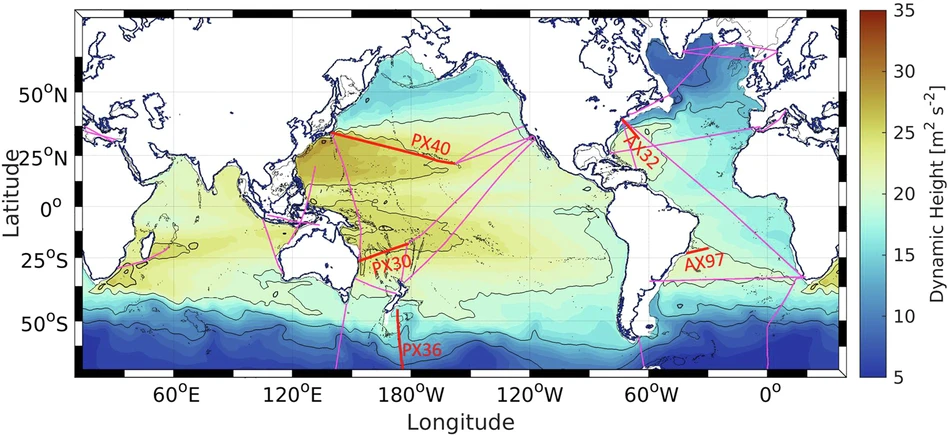
A recent study introduced GOXBT, a new gridded ocean product built from repeated expendable bathythermograph observations collected along major ship transects across the global ocean.
Major ocean currents such as the Gulf Stream, Kuroshio, Brazil Current, East Australian Current and Antarctic Circumpolar Current (ACC) play a central role in redistributing heat, salt and momentum across ocean basins. They influence climate variability, coastal sea level, marine heatwaves and exchanges between ocean regions. However, their narrow cores, sharp fronts and strong mesoscale variability make them difficult to resolve using broad-scale observing systems alone.
GOXBT transforms quality-controlled XBT temperature profiles into standardized gridded sections and provides temperature, derived salinity and absolute geostrophic velocity across five major current systems. This makes it possible to describe and compare the structure of these currents within a consistent observational framework.
Among the different current systems included in GOXBT, here we highlight the Antarctic Circumpolar Current, the largest current system in the global ocean and a key component of the Southern Ocean circulation. In the study, the ACC is sampled along the PX36 transect, which crosses the Southern Ocean between New Zealand and the Ross Sea.

Figure 1. Mean temperature, derived salinity and absolute geostrophic velocity along the PX36 transect across the Antarctic Circumpolar Current.
Along PX36, the mean temperature section was derived from XBT observations, while a climatological salinity section was reconstructed. These fields were then used to estimate the absolute geostrophic velocity, providing a cross-sectional view of the current structure. The resulting velocity field makes it possible to identify the main frontal systems of the ACC and relate them to the underlying temperature and salinity structure.
Together with additional comparisons against independent observing systems, the product provides a new resource to study boundary-current variability, evaluate ocean models and reanalyses, and strengthen the connection between in situ observations and satellite-based ocean monitoring.
Reference: Goes, M., Dong, S., Cowley, R. et al. A high-resolution boundary current product from Gridded Observations of eXpendable BathyThermograph (XBT) transects. Sci Data13, 660 (2026).
For further details, refer to the full paper: https://doi.org/10.1038/s41597-026-06883-3