

EarthCARE observations of marine stratocumulus clouds
- Project by: Johanna.Mayer@esa.int
- May 14, 2026
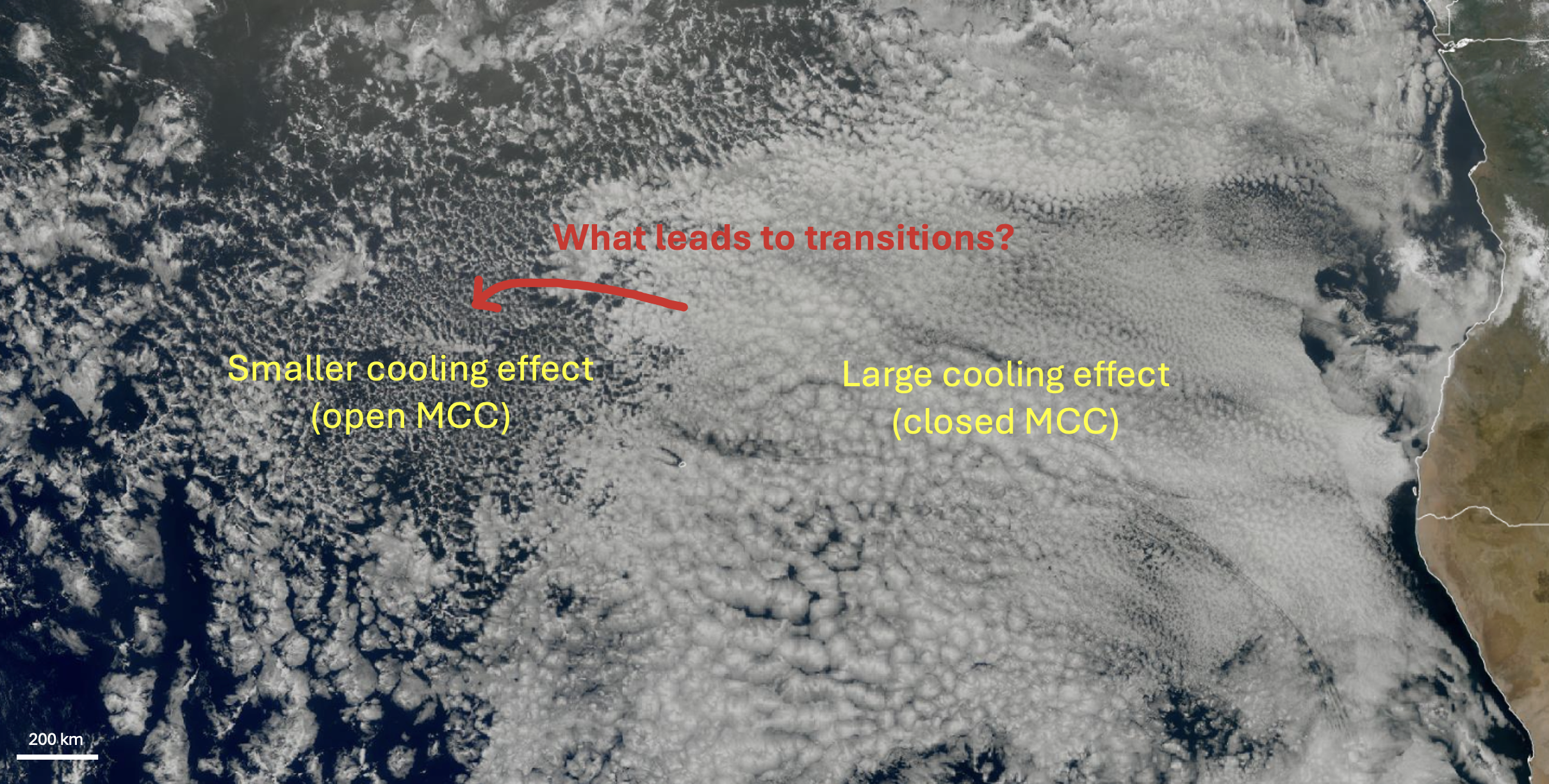
Marine stratocumulus clouds play a pivotal role in Earth’s climate system, as they cover large areas and reflect much of the incoming solar radiation back to space, thereby cooling the Earth. Changes in their properties can greatly affect this cooling effect and, consequently, the global climate. This research project focuses on understanding the horizontal patterns of clouds, i.e., their mesoscale structure. The MTG image above shows how changes in cloud mesoscale structure, such as a transition from closed to open cells, can greatly impact the cloud albedo and consequently their cooling effect. It is therefore important to understand when and why transitions from one cloud structure to another happen.
The EarthCARE satellite enables for the first time simultaneous spaceborne measurement of cloud mesoscale structure, and detailed observations below cloud top. EarthCARE’s active sensors (ATLID and CPR) can resolve the vertical profiles of marine stratocumulus, overcoming previous limitations due to ground clutter, and allow observations of microphysics, such as precipitation, liquid water content and droplet size. The multi-spectral imager (MSI) adds spatial context, capturing cloud cover and the mesoscale structure of clouds.
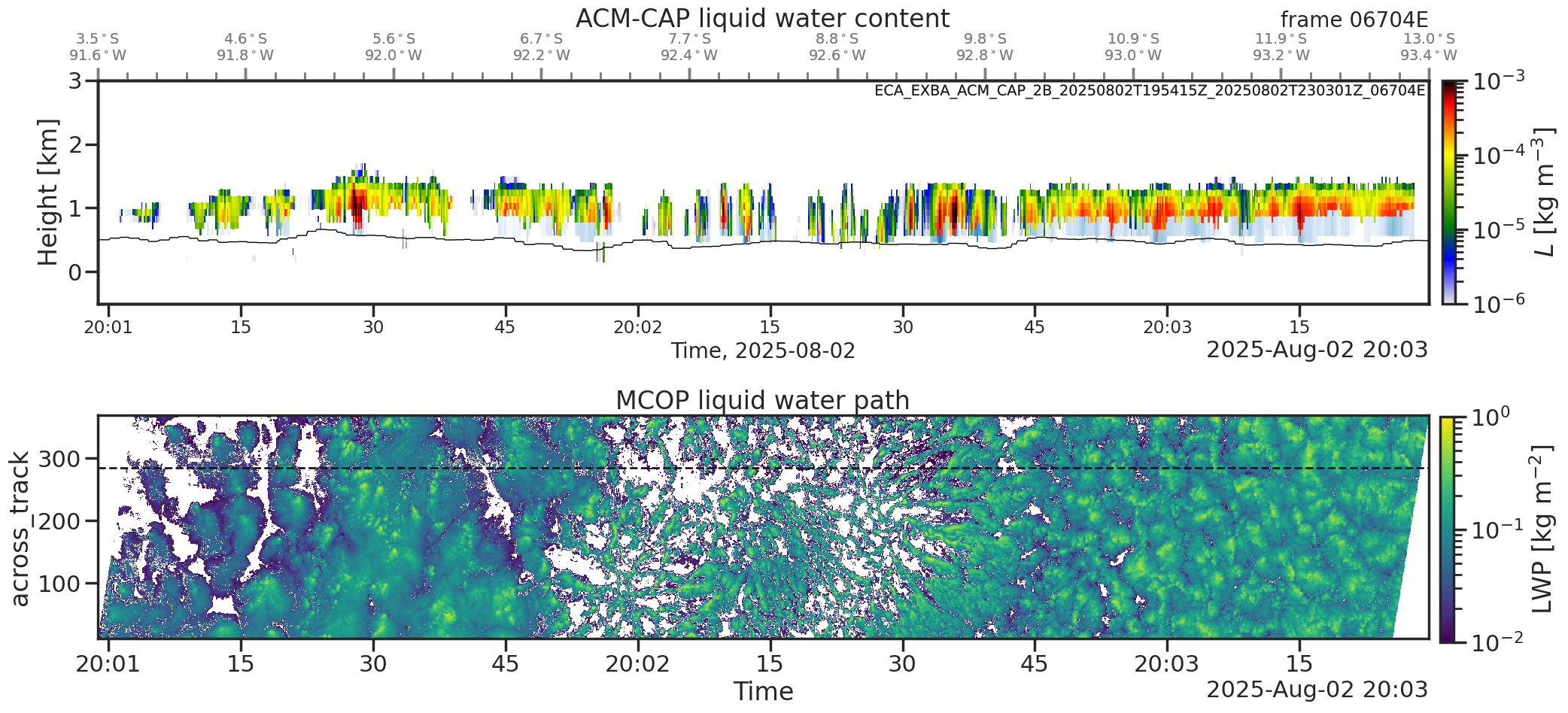
We use a convolutional neural network (CNN) with MSI data to identify cloud structures and analyze their microphysics using EarthCARE’s active sensors. Initial analysis shows open and closed cells have similar vertical extents and surface coupling, but open cells produce heavier and more frequent rain.
To understand why transitions between structures happen, we use data from geostationary satellites and ERA5 wind trajectories to track the clouds measured by EarthCARE in time. This enables us to determine when closed cells observed by EarthCARE become open cells, and when open cells were previously closed. Initial findings suggest that transitions from closed to open cells are mainly driven by microphysical processes: before transitioning, closed cells show increased rain but no significant changes in cloud top height or surface decoupling.
This study offers important insights into the cloud processes responsible for transitions between different cloud structures. A comprehensive understanding of these mechanisms is essential for assessing how the cooling effects of clouds may change in response to our changing climate.