

ML-TWiX: extending satellite-based water storage records back to 1980
- Post by: Science Hub Team
- April 16, 2026
Karim Douch, Dr, Internal research fellow @ Esrin Science Hub,
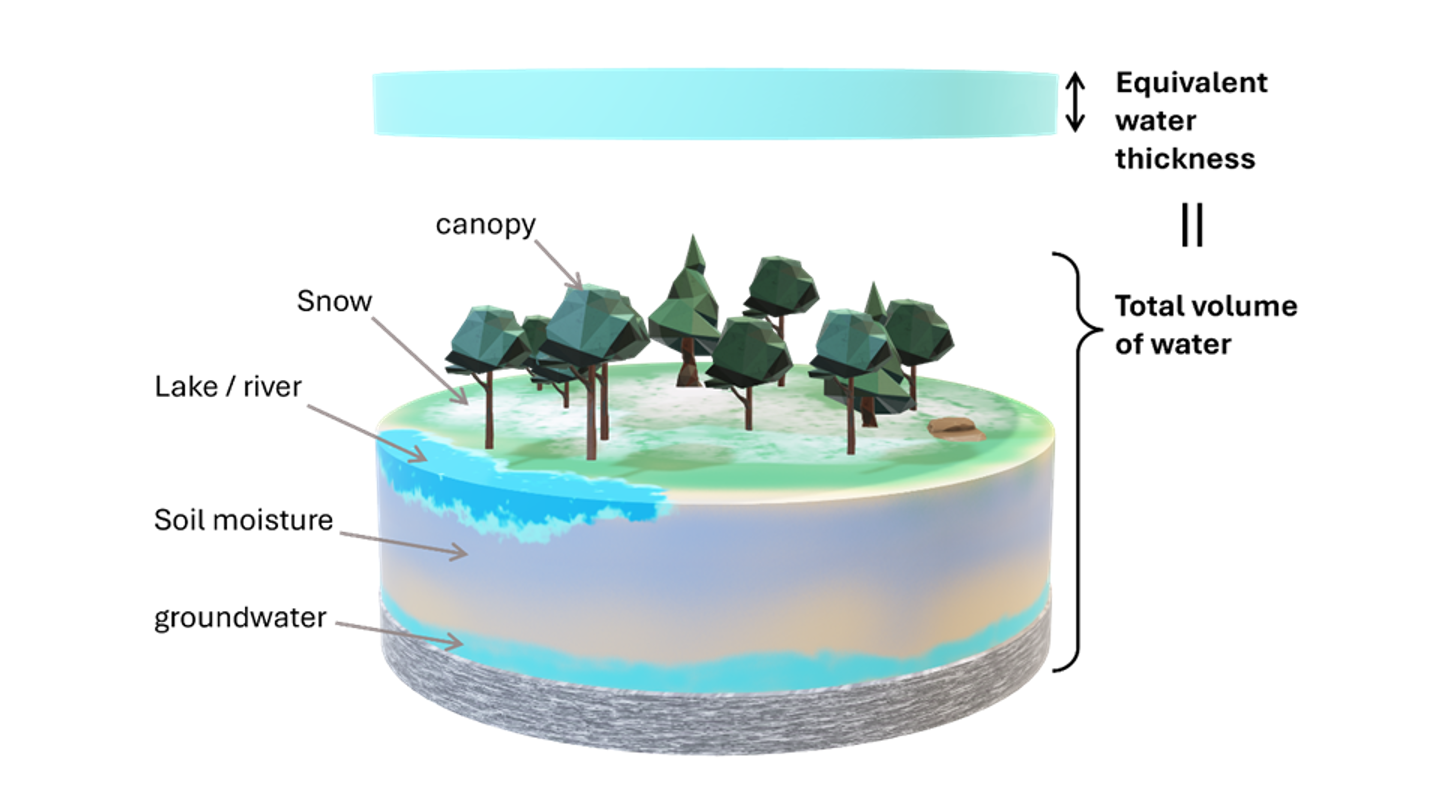
Understanding long-term changes in terrestrial water storage is essential for monitoring droughts, floods, and climate-related shifts in the global water cycle. Over the last two decades, the GRACE and GRACE-FO satellite missions have transformed this field by providing observations of total water storage anomalies (TWSA), integrating changes in groundwater, soil moisture, snow, surface water, and other land water stores. However, their combined observational record spans only a little more than two decades, which limits their use for long-term climate analyses.
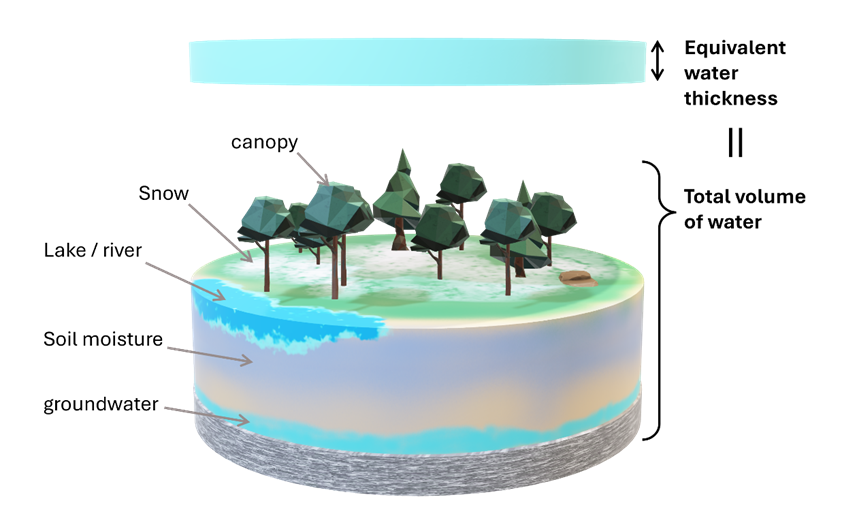
Our recent study introduces ML-TWiX (“Machine Learning-based Total Water storage anomaly eXtension”), a new global dataset that reconstructs monthly TWSA from 1980 to 2012 on a 0.5° × 0.5° grid. The dataset extends the GRACE-era signal into the pre-GRACE period by combining Earth observation with machine learning and model-based hydrological information. In particular, GRACE observations from the satellite era are used to train three machine learning models—Random Forest, XGBoost, and Gaussian Process Regression—which learn how to reconstruct large-scale water storage variations from hydrological and land-surface model simulations. Their predictions are then combined into one ensemble product with spatially explicit uncertainty estimates.
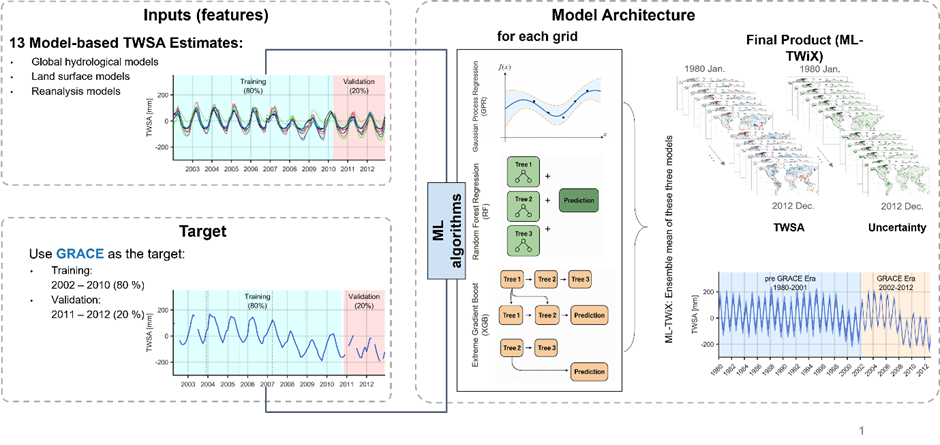
The strength of ML-TWiX lies in its close connection to Earth observation. Rather than replacing satellite observations, the dataset uses GRACE as the reference needed to transfer EO-based knowledge into earlier decades where direct satellite gravimetry is not available. In this way, ML-TWiX preserves the added value of satellite observations while expanding their temporal reach for climate-scale applications.
We evaluated the dataset against several independent references, including satellite laser ranging (SLR), water-balance-based storage estimates, and the global mean sea level budget. These evaluations show that ML-TWiX performs comparably to or better than existing long-term reconstructions in many cases, while also providing uncertainty information that is useful for scientific interpretation.
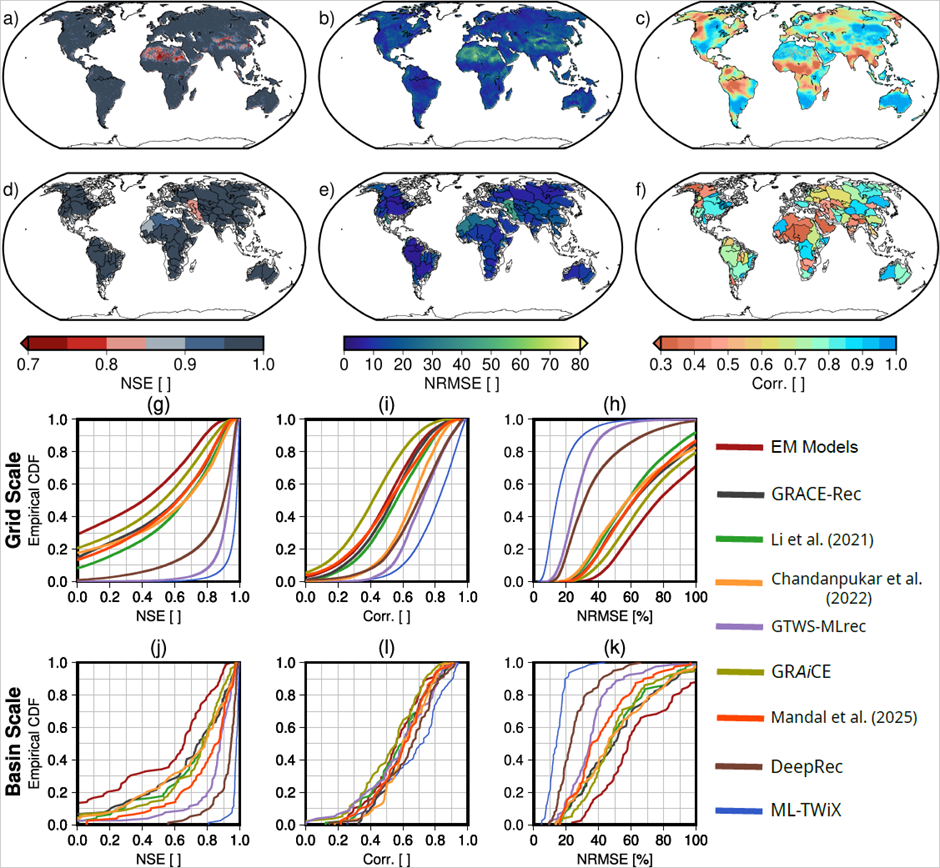
By extending satellite-informed water storage records back to 1980, ML-TWiX supports studies of multi-decadal hydrological variability, climate change impacts, and water resource assessment at regional to global scales. The dataset opens new possibilities for exploring how water storage has evolved before the GRACE era, while keeping the analysis anchored to the observational strength of Earth observation.
Link to the article : https://doi.org/10.1038/s41597-026-06604-w
Tags : Water storage, GRACE, Machine Learning