

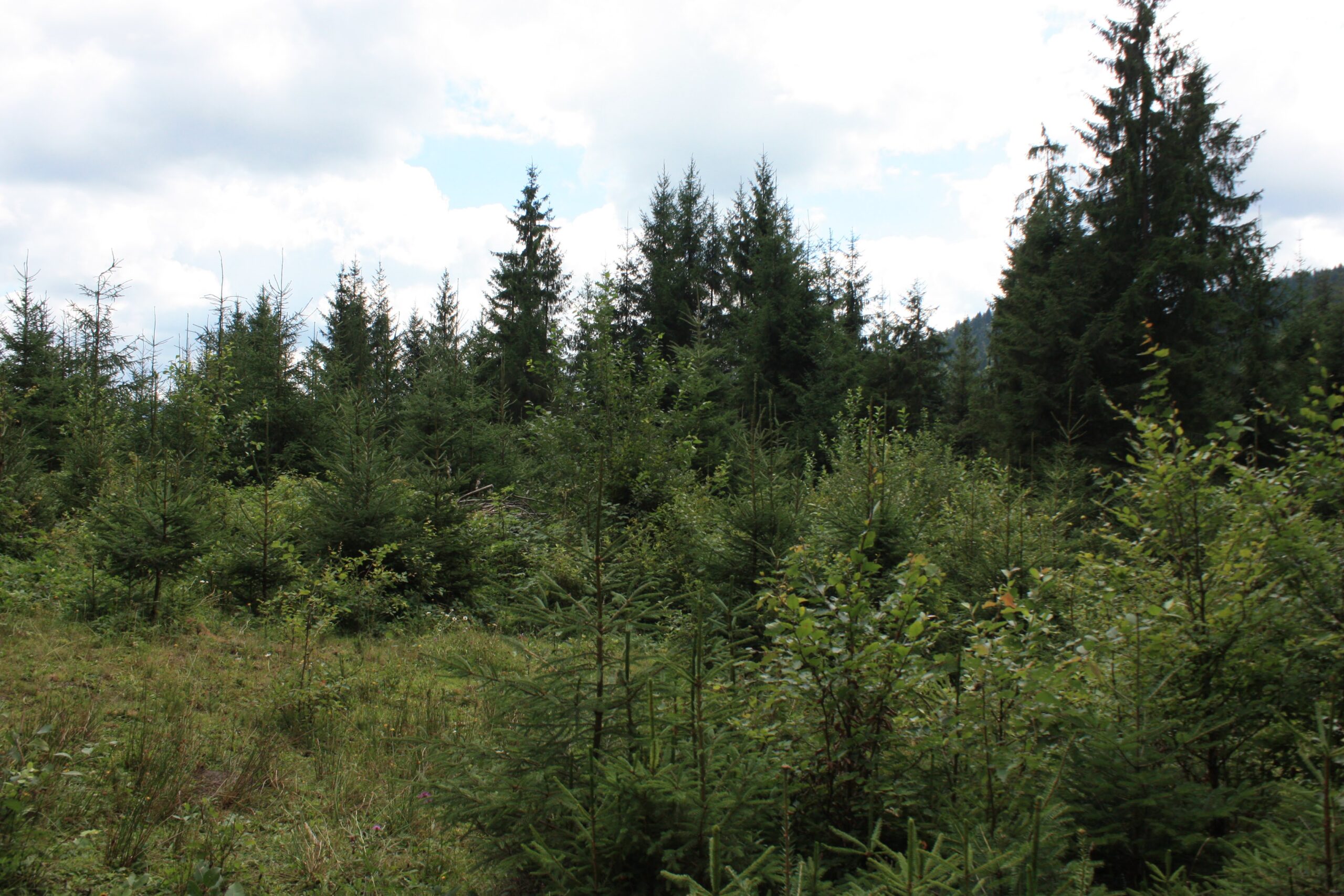
Canopy structural complexity promotes European forest resilience
- Post by: Agata Elia
- November 11, 2025
Agata Elia, Dr, Internal Research Fellow @ Esrin Science Hub
A recent study highlighted the relationship between forest structural diversity (FSD), an aspect of functional diversity, and ecosystem resilience of Central and Southern European forests.
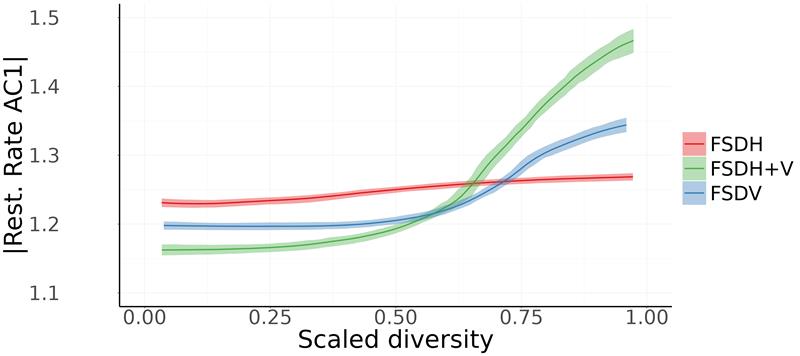
In this study, the resilience of European forests was quantified using two Critical Slowing Down (CSD) metrics: the 1-lag autocorrelation (AC1) and the variance derived restoration rates of forests from long-term perturbations. These metrics were computed from a time-series of kernel Normalized Difference Vegetation Index (kNDVI) at 0.05∘ and 8-day spatial and temporal resolution, from MODIS Terra and Aqua datasets, ranging from 2003 to 2021. Structural diversity was instead represented by three GEDI-derived FSD metrics: horizontal (FSDH), relating to spatial variability in the canopy height , vertical (FSDV), relating to evenness of the vertical vegetation distribution, and combined (FSDH+V), representing complexity in canopy substructure.
To isolate the link between FSD and resilience from the confounding environmental factors, the authors applied a Random Forest (RF) modelling framework, controlling for climatic, topographic, soil and forest-cover variables. A positive relationship between FSD and forest resilience was found in approximately 80% of the forest area studied for the combined FSDH+V metric. Among the FSD components, the combined FSDH+V (horizontal + vertical) had the strongest predictive power for resilience, followed by vertical diversity alone (FSDV), and lastly horizontal variability alone (FSDH).
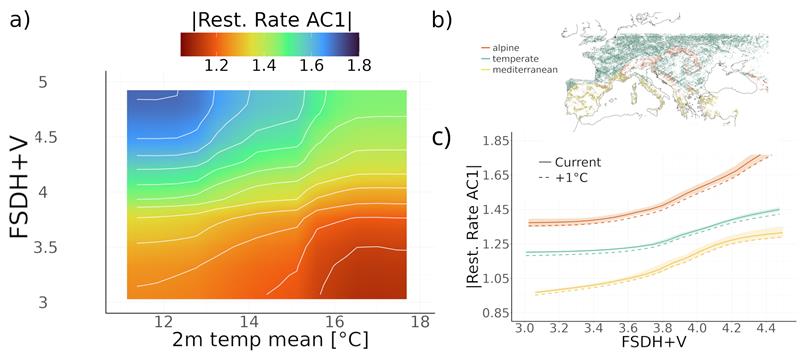
The authors further explored whether increases in FSD could compensate for an increase of 1°C in mean background temperature, by examining the partial dependence of resilience on FSD across biogeographical regions (Alpine, Temperate, Mediterranean) and estimating the relative FSD increase required to maintain the same resilience under warming. When evaluating this climate-resilience-FSD interplay, the authors estimated that for a +1°C warming scenario, maintaining current resilience levels could require relative increases in FSDH+V of ~4.8 % in Alpine, ~7.1 % in Temperate and ~10.2 % in Mediterranean forests (median values), assuming other factors constant and without accounting for all climate change dimensions.
The findings suggest that management practices promoting canopy structural complexity such as mixed age stands, multi-layered canopies or heterogeneous crown sizes, could promote forest resilience to perturbations and may partly offset the negative impacts of warming. This positions structural diversity as a concrete tool for forest adaptation strategies under climate change.
Reference:
Pickering, M., Elia, A., Oton, G., Piccardo, M., Ceccherini, G., Forzieri, G., Migliavacca, M., Cescatti, A. & Girardello, M. (2025). Enhanced structural diversity increases European forest resilience and potentially compensates for climate-driven declines. Commun Earth Environ 6, 852 (2025). https://doi.org/10.1038/s43247-025-02592-8
For further details, refer to the full paper: https://doi.org/10.1038/s43247-025-02592-8